What you need to know about recommended soccer goal size by age When it comes to creating a safe, fun, and educational atmosphere, the knowledge of what the appropriate soccer goal size by age is an absolute must for any league organizer, coach, or head of household. Selecting a proper soccer goal size by age allows the young ones to focus on acquiring real shooting accuracy, passing sequences, and handling traits without straining their young muscles.
If club officials adhere rigidly to standard regulations with regard to the variations of soccer goal size by age, they establish an equal contest day setting where both keepers and strikers can gain real confidence in the field. By setting the right soccer goal size by age at practice on a weekly basis, youth academies can ensure the full-size senior pitches transition smoothly and naturally. In the end, staying within the recommended soccer goal dimensions for age is what makes the game of youth soccer safe, competitive, and sized perfectly for the kids playing it. Before choosing a youth goal, parents should also check the https://cricproz.com/soccer-ball-size-chart/ so children train with equipment that matches their development level.
Table of Contents
1. THE GRASSROOTS TOP TIP: UNDER-6 TO UNDER-8 BRACKETS
Tots and young children out for their first kickabouts on Saturday mornings at playfields are hardly aware of the tactical formation or the presence of an official referee. The soccer goal size by age fundamental goals at this stage are all energy, every player touching the ball, and falling in love with the game.
MICRO-TARGET DESIGN FOR SMALL-SIDED PLAY
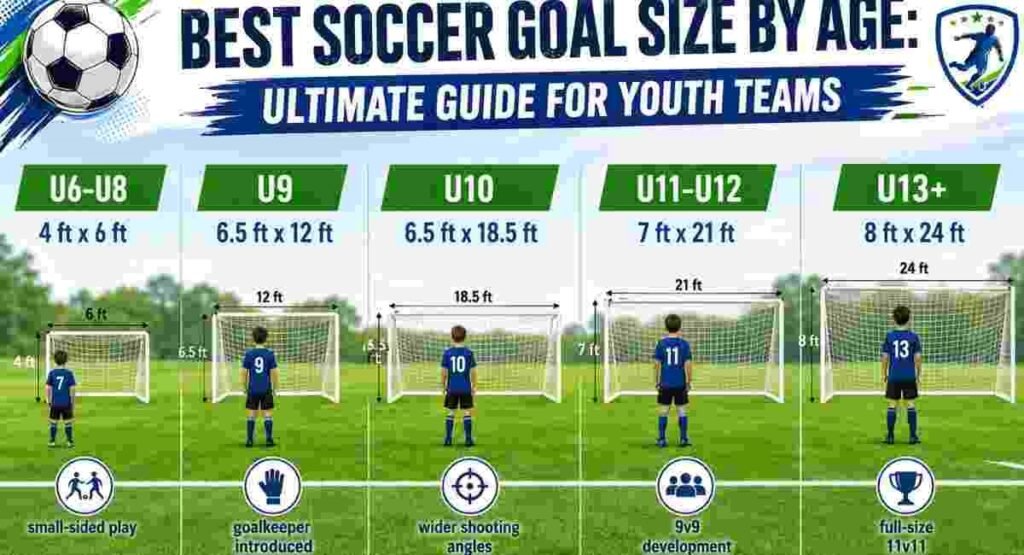
Positions: No goalkeeper For the U6, U7, and U8 age groups, the laws of the game are adapted to eliminate the formal position of goalkeeper. Without a keeper in the net, putting up a giant frame would only lead to an insane score line that doesn’t help anyone get better. Instead, teams use mini pop-up nets that conform to the minimum soccer goal size by age; these nets are 4 feet high by 6 feet wide. This small size encourages children to look up, stop the ball with their feet, and pass or shoot into a small target rather than just boot the ball as far down the field as they can.
PROMOTING MAXIMUM TOUCHES PER PLAYER
Small-sided games, commonly at 3v3 and 4v4 (and 5v5 or 6v6 for older kids) on small fields, are all about simplicity. By reducing the size of the goal frames, the entire game is played in a smaller space, and that allows you to maximize the number of touches that every player gets per minute. In this level, this approach to the size of the soccer goal size by age for grassroots soccer means parents don’t have to worry about real rules like offsides or throw-ins. To explore how small-sided match variants accelerate technical growth, check out the US Youth Soccer Official Grassroots Development Framework.
2. THE TRANSITION AND INTRODUCTORY PHASE: UNDER-9 SPECIFICATIONS
The Under-9 leap is the step-up that soccer enthusiasts agree is one of the soccer goal size by age most significant transitions in a young player’s soccer journey. This is when casual play in backyards becomes a more formalized and organized team game. At this stage, learning https://cricproz.com/soccer-positions-by-number/ also helps young players understand defenders, midfielders, forwards, and goalkeepers more clearly.
THE GOALKEEPER POSITION WELCOMED
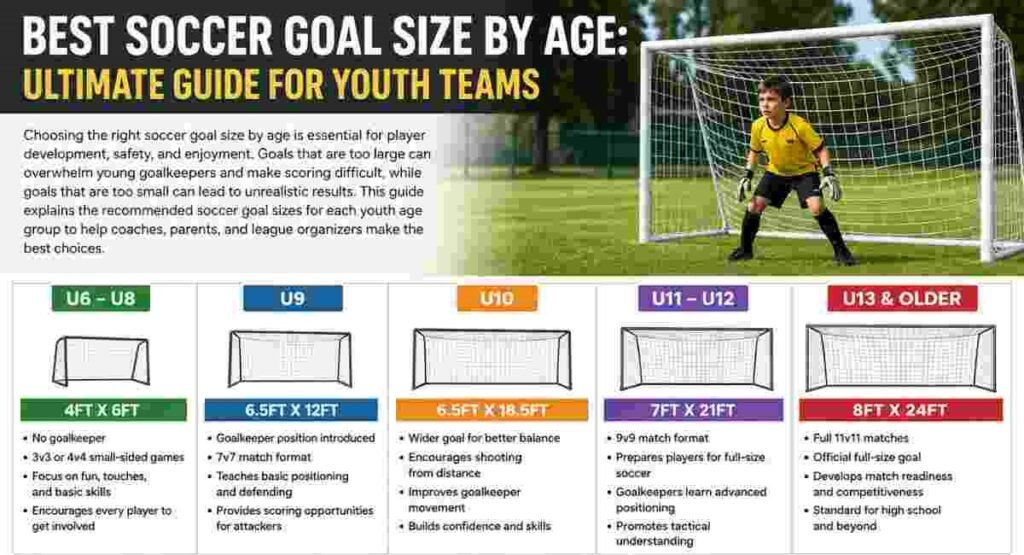
At the U9 stage, leagues officially bring the goalkeeper into the soccer goal size by age match structure. Since a player now defends the net, the goal frame must grow so the offensive side has at least some openings to put the ball in. The standard size for this category is 6.5 feet high by 12 feet wide. This should allow the inexperienced young goaltenders a fair chance to cover the posts while, at the same time, advancing attackers to put shots in the corners.
GETTING USED TO THE 7V7 MATCH FORMAT
With the addition of keepers, the game jumps up to 7v7 on a substantially bigger field. Players have to begin to understand simple positional lines, such as tracking defenders, midfielders, and forwards. Using the recommended soccer goal size by age 6. A 5 x 12 soccer net size is a fine practice device that can help young ones to learn to cross the ball from across the sidelines into the center of the box for a teammate incoming to make a clean, trembling shot.
3. WIDENING THE MIDFIELD STRIP: UNDER-10 FIELD MODIFICATIONS
To keep pace with the increasing size of the players, the dimensions of the penalty box and the soccer goal size by age and goalposts receive another significant modification. Young players also need https://cricproz.com/best-budget-wide-football-boots/ so they can shoot, turn, and move with better balance.
DISTENDING THE RECTANGLE TO 18.5 FEET
Though the height of the crossbar remains fixed at 6.5 feet (this is due to the general height of ten-year-olds), the length of the frame is significantly extended. At this stage, the relevant soccer goal size by age guidelines scale is 18.5 feet. That horizontal space is necessary, because at this age players are beginning to have the leg strength to shoot from distance. A larger net means young defenders have to come out and take shots early rather than just sitting back inside their own 3-second box!
WORKING FOR A BALANCE IN LEARNING ENVIRONMENTS
At 18.5-feet-wide soccer goal size by age, the goalkeepers start working on their lateral footwork and diving, and the attackers learn how to curve shots around defensive walls. It leads to a fun, symmetrical game where games are not decided by random chance but by intelligent passing and neat team coordination.
4. THE PRE-COMPETITIVE JUMP: UNDER-11 AND UNDER-12 FRAMEWORK
The Under-11 and Under-12 divisions are the ultimate development stages before young athletes enter the full-size, adult-run club soccer experience. Parents and coaches can also use https://cricproz.com/smart-watches-for-football/ to track running, effort, and fitness during youth practice sessions.
THE 7X21 INTERMEDIATE NET
In the U11 and U12 age groups, leagues adopt a 9v9 game format, and they wouldn’t increase the soccer goal size by age to 7 feet tall and 21 feet wide. Age-based transitions to this intermediate-sized soccer goal can be challenging too, as keeping the top corners of the net for young keepers is a feat requiring a considerable amount of physical effort.
At this level coaches spend a great deal of time teaching keepers how to position themselves in relation to the ball, and they do so to make sure the soccer goal size by age netminders maximize their chances of making a save, and they make sure keepers don’t find themselves too far away from their goal line in a breakaway situation.
SETTING ATHLETES UP FOR THE TACTICAL PITCH
A 9v9 pitch of 7 x 21-sized soccer goal size by age set size promotes young players to be more tactically formed. Midfielders need to be taught to switch the direction of the play with long, high passes, and wide wingers must be taught to deliver accurate crosses into the danger area. It serves as an ideal stumbling block, allowing players to build up the fitness and tactical knowledge required for what in a few years’ time they will encounter.
5. REGULATION: UNDER-13 AND UP (ADULT SIZE)
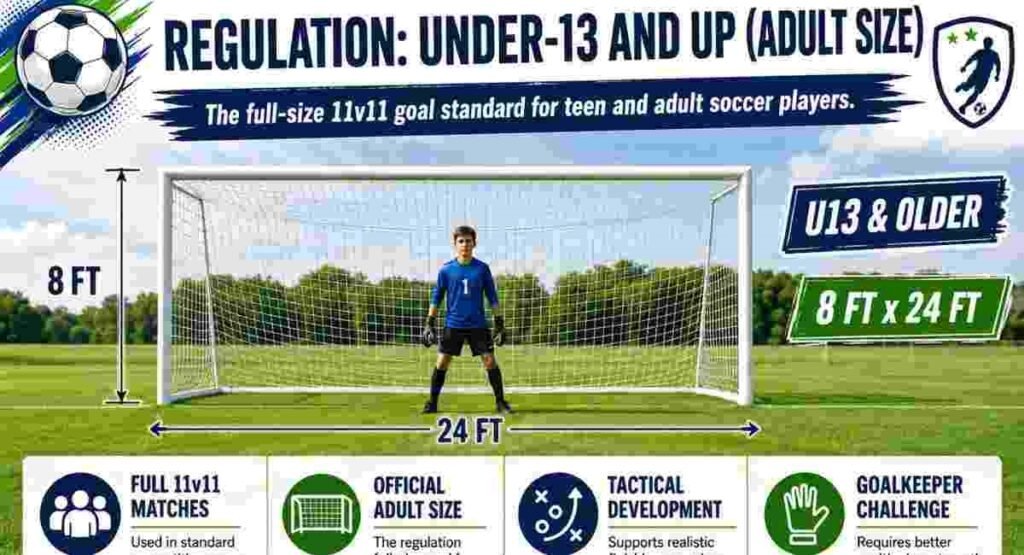
An athlete turns thirteen and takes the pitch for an Under-13 game, and they are now playing by the very same rules, on the same dimensions, under the same standards as the professional club stars worldwide who score soccer goals by age.
THE WORLD-WIDE 8X24 PRO DIMENSIONS
From U13 up through the high school, college, and adult premier levels, the final soccer goal size by age is capped at 8′ x 24′. This huge physique requires that the keeper be in top physical condition, have quick jumping reflexes, and be shouting and communicating constantly. For strikers, hitting twine in a full-size net is synonymous with being in clinical finishing form, high levels of composure, and shooting power.
FULL-SCALE 11V11 TACTICAL WARS
Attaining this official soccer goal size by age group means that teams completely switch over to the traditional 11 players per side match on a large, full-sized field. The game becomes much more about technique, with formations, offside traps, and specialized player assignments. When an athlete can command the full size of a full-sized field, that is the ultimate test for a young athlete becoming a full soccer player. Review the complete pitch specifications and goal outline directly inside the official FIFA Laws of the Game Equipment Regulations.
6. ANCHORING AND PRACTICE SAFETY: DOING RIGHT BY THE KIDS
THE HAZARDS OF UNANCHORED FRAMES
Whatever size of soccer goal size by age you choose, large aluminum or steel frames can be a potential falling hazard when a child hangs from the crossbar or if strong gusts of wind pull at the netting during a storm. Preventable injuries occur every year because an adult failed to secure a net at practice or at home.
HOW TO TETHER YOUR NETS
We do have soccer equipment, including soccer goal nets and heavy-duty steel J-hook anchors that are used to secure a goal frame according to the ANSI size soccer goal size by age for your league or home style of play. Before blowing the whistle to start any practice or weekend game, coaches need to take a moment to actually go over to both nets (yes, both) and give the posts a shake to make sure they’re as solid and kid-worthy as possible. Read the comprehensive institutional safety brief regarding stable goal setups via the ANSI Soccer Goal Tip-Over Prevention Standards.
7. HOME TRAINING SYSTEMS: SELECTING THE BEST HOME GOAL PRODUCT
When it comes to buying a training net for the soccer goal size by age yard so their children may work on shooting and footwork after school, parents can be confused by the commercial offerings. A backyard goal works best when it is paired with proper https://cricproz.com/youth-football-training-equipment/ for safe and useful practice.
MULTI-SPORT POP-UP NETS VS. SOLID FRAMES
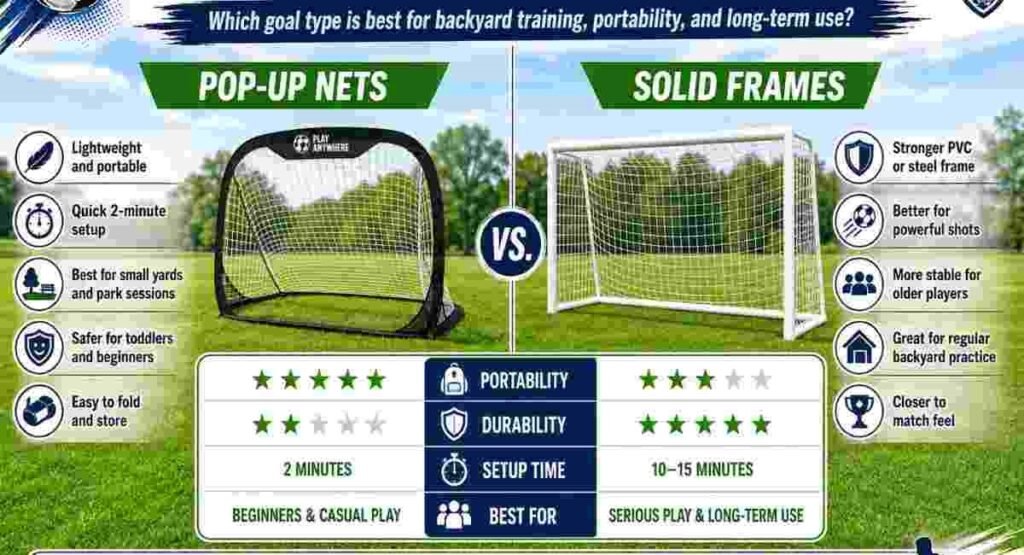
If you have limited space or want something you can easily fold up and throw in the car for trips to the park, the pocket-size fiberglass pop-up net is the way to go. They are inexpensive, you can have them both up and down in less than two minutes, and they are completely harmless to toddlers. But if your kid is older, you may want to consider getting a sturdy weather-resistant PVC or steel frame that is made to hold up to heavy impacts and not fly away and that will match their size of standard soccer goal by age tier.
BRINGING YOUR HOME SETUP IN LINE WITH WHAT’S IN YOUR LEAGUE
To encourage your kid to develop good muscle memory, try to consult a soccer goal size by age chart and get your backyard net size aligned with the official size used by their weekend league. If your 8-year-old plays on a 6.5 x 12-foot net on Saturdays, her aim might be “off” if she practices in the basement on the tiny 4-foot net. Giving them a real practice target in the yard makes going to real match days a breeze.”
CONCLUSION:
When it comes down to it, properly laying out your field with the right soccer goal size by age standard is one of the simplest ways to keep youth soccer safe, fair, and so much fun. As a child gets taller and stronger, the competition level on the pitch increases in kind; this is what it makes sure of.
From club coordinators (field layout for big weekend tournaments) to parents (creating a fun shooting station in the backyard), adhering to standard soccer goal size by age remains the defining factor ensuring every young player has the appropriate environment to succeed, learn, and fall in love with the beautiful game.
Frequently Asked Questions (FAQs)
Q1. What would the effect be if a youth league adopted an adult net (8 x 24) for nine-year-old players?
Answer: Running an adult net for little kids totally shatters the soccer goal size by age balance of the game. They physically just can’t get up to the crossbar, and then they get frustrated and give up, and the strikers don’t learn how to shoot because every high kick is an easy goal.
Q2. How do you anchor a soccer goal on a hard surface in an indoor gym?
Answer: Heavy metal stakes can’t be pushed into the soccer goal size by age, dirt on gym floors, or indoors on turf. Get special heavy-duty rubber counterweights or jumbo, secure sandbags—lay them or rest them. They can be pushed into the dirt on gym floors or indoors on turf.
Q3. Are the sizes of the youth soccer goals the same for boys and girls?
Answer: Yes. The youth soccer groups, such as US Youth Soccer and FIFA, have the exact same soccer goal size by age, field size, and ball size requirements for boys’ and girls’ age-based divisions for all tiers of play.
Q4. Why does the net width increase at U10 with the crossbar height staying at 6.5 feet?
Answer: Ten-year-olds are getting fatter and putting on more in that direction than height for their major teen growth spurt. With the crossbar at 6.5 feet, they can still cover the upper part of the net, but now the 18.5-foot-wide frame also forces the defense to cover the soccer goal size by age outer wings.
Q5. What material is best for an outdoor soccer goal to last?
Answer: For the permanent outdoor unit that is used outside in winter and summer, the best material is powder-coated steel or aircraft-grade aluminum frames, as they are the most durable and won’t rust from the rain, nor will they be affected by extreme cold or hot weather.
Q6. Are the goals in short-sided tournament play the same standards as full league play?
Answer: No, not always. Fast-paced weekend tournaments and 3v3 weekend cups will often opt for small, low-profile pop-up nets to really get the speed passing, quick individual touches, and rapid shooting transition going.
Q7. How often should coordinators of clubs monitor field anchors for safety?
Answer: Volunteer club members as well as the coaches need to check every field anchor, net tie, and post bracket before every single practice and game to ensure that nothing has become loose.
Q8. Would the size of the ball, a wrong size, make the user play a shooting game at a goal net?
Answer: Absolutely. Attempting to kick a heavyweight, full-size Size 5 ball could cause a young child’s leg muscles to cramp and could lead to them practicing poor shooting form. Just sticking to the recommended sizes (e.g., size 3 or 4), they will be able to shoot cleanly and safely into the net.
Q9. Why do modern soccer goals have a depth bar along the post and crossbar?
Answer: Depth bars provide real three dimensions to the net by keeping the mesh material from hanging vertically. The arrangement keeps the ball from bouncing back into play where an official might have trouble seeing it, making the ball available to the referee every time a goal is scored.
Q10. Where can I find official goal size charts for my town league?
Answer: The simplest method is to look at the official online handbook of your local youth soccer organization or consult the general youth development standards that are made available by your nation’s soccer federation.