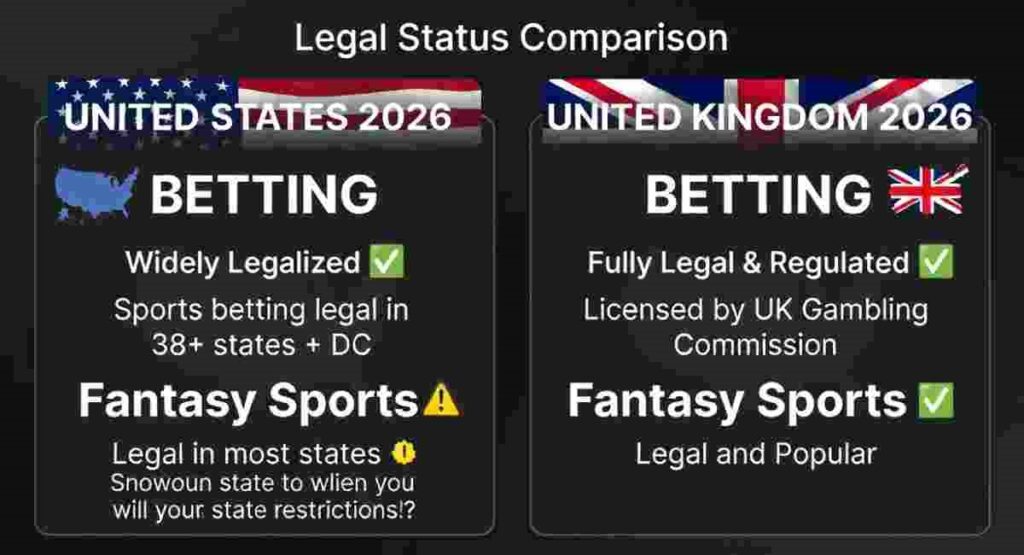
The betting vs fantasy debate has boiled over in 2026 as worldwide regulation changes. Though both require the player to predict the outcome of sports, the rules for betting and fantasy remain wildly different in key markets like the USA and UK. If you want to play on either of these platforms, it’s important to know the essential differences between betting vs fantasy so as not to get caught up in a legal mess.
By 2026, the rise of digital sports has made the betting vs. fantasy divide less clear, but the “game of skill” versus the “game of chance” matter still defines the industry. Whether you are a casual player, high-stakes player, or anything in between, having an understanding of the current status of betting vs fantasy will allow you to play both safely and legally.
Table of Contents
1. THE KEY DISTINCTION: SKILL VS. CHANCE 2026
The main reason betting vs fantasy are considered different by law comes down to the “Predominance Test.” This is the legal test to decide that a game’s outcome is more dependent on the player’s skill rather than random chance or luck.
In the betting vs fantasy debate, fantasy sports are classified as a “game of skill” in nearly all circles. You need to act as a virtual team manager if you want to win. You are not just selecting a winner; you are reading weather forecasts, pitch conditions, injuries to players, and history of strike rates. It’s “your” skill that wins or loses, since you’re building a team in a best-of-series or tournament across multiple matches and not picking a single player in a single match.
On the other side, betting on sports is usually considered a “game of chance” or a straight wager. Betting on India to win a game against Pakistan is a single bet. No matter how hard you work, one bad drop or a sudden rain shower can mess up the bet. Operating regulators distinguish between betting vs fantasy in 2026 for the purpose of taxation and licensing betting vs fantasy platforms in different legal categories.
2. LEGAL STATUS IN THE UNITED STATES (2026 UPDATES):
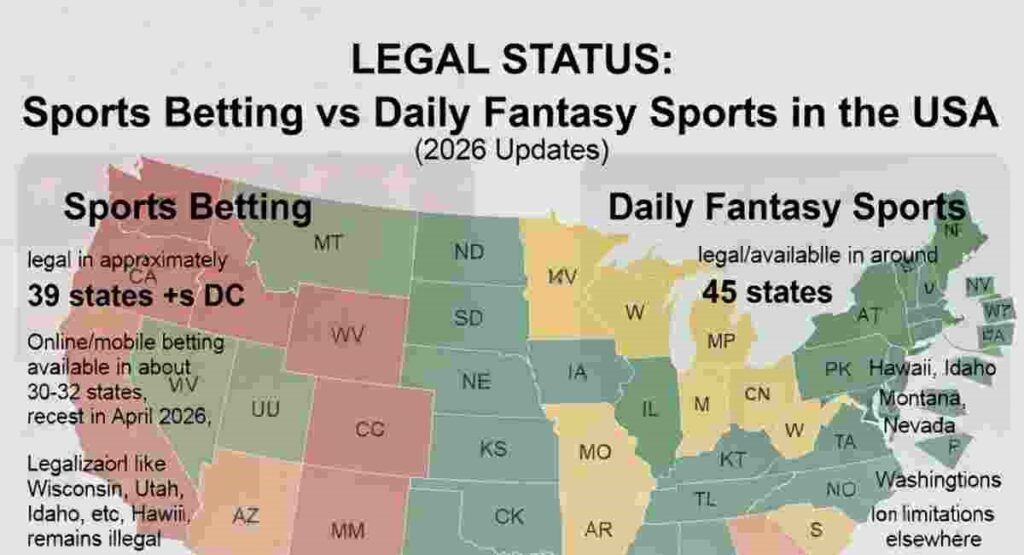
Betting vs fantasy in the USA is a case of determining legal status separately by each state, so there is a “patchwork” of laws that can become more confusing for fans. If you are looking to master these platforms, check out our guide on the https://cricproz.com/dream11-grand-league-winning-strategy-2026/ to stay ahead of the competition.
For FAR: The backbone of fantasy sports is the 2006 Unlawful Internet Gambling Enforcement Act (“UIGEA”). It clearly established a “safe harbor” for fantasy games as a lawful skill contest. But sports betting was prohibited at a federal level until the state of New Jersey challenged various portions of the Professional and Amateur Sports Protection Act (PASPA) in a precedential legal case.
U.S. REGULATIONS: What is the status of sports betting in the US? As of 2026, more than 40 states have made sports betting legal and regulated. But huge markets, like California and Texas, are still caught up in a punting vs fantasy war. In some states, land-based sportsbooks are illegal, but Daily Fantasy Sports (DFS) sites are able to operate in a “gray area.”
THE FANTASY ADVANTAGE: Platforms like Dream11 (US version) and Prize Pick have successfully navigated these laws. They have “Pick’em” contests in states where sports betting is not yet legal, suggesting that opting for “more or less” on a player’s stats involves a high level of analytical skill—not just wagering on a final score. The legal framework for fantasy sports in the United States was largely shaped by the Unlawful Internet Gambling Enforcement Act (UIGEA) of 2026.
3. THE UNITED KINGDOM: A UNIFIED REGULATORY MODEL
The beauty of the UK market is that it has been established longer and is more developed than most for betting vs fantasy alike. Instead of hiding behind “skill vs. chance” definitions to ban one or the other like the US does, they just treat them all like games and throw regulations on everything.
UK GAMBLING COMMISSION (UKGC): The UKGC regulates the whole betting vs fantasy market. They are on the same platform; a “fantasy license” is not a “general betting license.” The UK approach is more focused on consumer protection rather than on whether it should be counted as a sport or gambling.
TAXATION: It’s the biggest win for UK players. In 2026, earnings from betting vs fantasy are still tax-free for the people. The government levies taxes on the operators (the apps) rather than the players, and this has made the UK more attractive to the pro fantasy grinders worldwide. For players in the United Kingdom, all operations must strictly follow the guidelines set by the UK Gambling Commission to ensure fair play.
AFFORDABILITY CHECKS: One of the most significant 2026 updates in the UK are the “AI Affordability Check.” If a user is a high spender on betting vs fantasy apps, the user is automatically flagged for review to confirm they can afford the loss. That has made the UK into the most secure space for responsible gaming.
4. THE RISE OF “PICK’EM” GAMES: BLURRING THE LINES
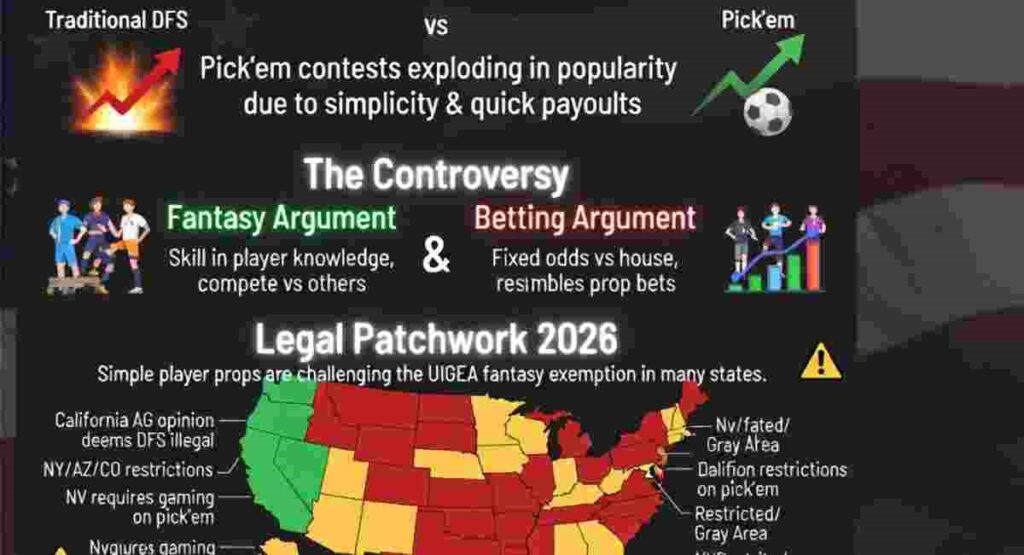
One huge trend for 2026 is the “Pick’em” style fantasy game, which has sparked a whole new controversy in the betting vs fantasy legal debate.
Users can bet on whether a player such as Virat Kohli will score above or below 40.5 runs. To the addict, it looks like a “prop bet” (gambling), but the apps market it as “fantasy.” Why? Because it enables them to do business in states where gambling is prohibited.
Legal Action 2026: States with regulators in New York and Florida are currently investigating these “Pick’em” apps. They need to figure out whether these games should be classified as gambling or fantasy. If they are classified as “gambling,” these apps could be faced with millions of dollars in back taxes, and they could be forced to close in states that don’t allow gambling.
5. TAXATION LAWS: WINNINGS IN USA VS UK
How the government taxes your winnings is a deciding factor in the betting vs fantasy debate.
USA (IRS RULES): THE US IS STRICT. For tax purposes, if you win over $600 in a year on any betting vs fantasy app, it is income. You will receive a 1099-MISC from the platform, and you are required to report it. In 2026, the IRS has tightened the noose on digital wallets so there’s no place to “hide” winnings.
UK (HMRC RULES): The UK considers betting vs fantasy a hobby and not a job (for most). Therefore, 100 percent of what you win is yours. HMRC may investigate if you are a pro and this is how you earn your living, but it is unusual.
6. SAFETY AND RESPONSIBLE GAMING 2026:
Bone up on betting vs fantasy because the 2026 technology revolution made it all much safer whether you’re into sports betting, fantasy betting, or both. The “House” had all the power, but no longer.
BLOCKCHAIN TRANSPARENCY: Several new betting vs fantasy ventures are relying on blockchain ledgers. On a public link, every entry and payout is logged, making it impossible for the app to “rig” results or delay your withdrawal.
AI SELF-EXCLUSION: If you start to feel addicted to betting vs fantasy in 2026, you can enable a “Global Kill Switch” that disables access to all your gambling and fantasy apps at the same time for a selected duration. According to the IRS Official Guidelines any sports gaming winnings exceeding $600 must be reported as taxable income.
7. THE 2026 CRYPTO INTEGRATION IMPACT:

As we approach 2026, the financial basis for betting versus fantasy is shifting towards decentralized finance (DeFi). In the United States, a number of offshore betting websites are now accepting stablecoins as a way of circumventing traditional banking limitations.
However, the risk of getting involved in illegal activity by using crypto in betting vs fantasy is high. In the US states still divided, the UK permits licensed operators to have use of crypto but under stringent AML (anti-money laundering) laws. Should you play on an unregulated crypto site for betting vs fantasy, you do not have any protection if the site turns out to be a scam. Play it safe in 2026 and stick to regulated “Fiat-to-Crypto” gateways that are endorsed by gaming commissions.
8. AI ALGORITHMS: IS IT STILL A SKILL GAME?
The betting vs fantasy legal debacle continues to fester, with a new headache emerging in 2026: AI-driven “Lineup Optimizers.” Detractors say when a machine is picking the team, there is no “skill” for the human player. If you want to use technology for your predictions, it is crucial to choose the right assistant. Check out our deep dive on https://cricproz.com/google-gemini-vs-chatgpt-2026/ to see which AI gives the most accurate sports data.
In the UK, the Gambling Commission has said it is considering moving users who purchase AI bots for betting vs fantasy into the professional tax bracket. In the US, there’s been some movement in some states to ban “Scripting,” –the use of programs to submit thousands of lineups in seconds. For the average player, it’s important to understand what AI means for Betting vs Fantasy ecosystem to remain competitive.
9. RESTRICTED ADVERTISING AND CELEBRITY SPONSORSHIP:
Betting vs fantasy app marketing has evolved dramatically in 2026. Mirroring the UK, a number of US states have prohibited athletes from participating in betting advertisements, citing the need to shield young people from harm.
The “Betting vs Fantasy” branding battle is now being waged via social media through “influencer affiliates.” In the UK, a clear AD or BetResponsibly label is mandated, but the US market is somewhat more relaxed, with the FTC beginning to go after influencers who promote betting vs fantasy apps without clearly stating the risks.
10. THE SOCIAL ELEMENT: FANTASY LEAGUES AS COMMUNITIES

Betting vs fantasy isn’t about the money in 2026: It’s about the “social capital.” Fantasy sports trump everything else here, because they’re based on season-long friendships/enmities at work and the like. Social rivalry is at its peak during major tournaments; see how fans are engaging in our latest coverage of the https://cricproz.com/ipl-vs-psl-2026-viewership-battle/.
Sports betting can be a solitary pursuit, but betting vs fantasy games such as Sleeper and Underdog feature chat rooms and “squad” mechanics. Regulators are usually more tolerant of social betting vs fantasy formats, as they feel less like “hardcore gambling” and more like a digital pastime.
CONCLUSION:
As billions of dollars are wagered on betting vs fantasy apps, fraud is a big concern. In 2026, “multi-accounting” (a person who owns 50 phones to play in a league) is the biggest threat.
Today’s betting vs fantasy sites now require biometrics and GPS to verify that players are where they say they are. In the US, if you’re caught “location spoofing” to play betting vs fantasy in a prohibited state like California, you can get banned permanently and even face legal action. The UK has comparable “Know Your Customer” (KYC) procedures, and they are pushed in real-time.
Frequently Asked Questions (FAQs)
Q1. Is the legal differentiation of betting vs fantasy just based on luck?
Ans: Yes, that’s right. Within the legal context of betting vs fantasy, fantasy is a “game of skill” in which a player’s knowledge prevails. Betting is a “game of chance,” based on the outcome of “a single event,” that may be influenced by “random luck.”
Q2. Can I do fantasy sports in us states where sports betting is illegal?
Ans: In many cases, yes. States like California and Texas prohibit sports betting, but you can still play daily fantasy sports (DFS) as they’re afforded different legal protections (UIGEA safe harbor).
Q3. Do I need to declare tax on betting vs fantasy earning in us?
Ans: No. In the UK, both betting vs fantasy winnings are tax-free for individuals. Taxes are paid by the operators to the government.
Q4. What is the IRS tax limit for betting vs fantasy in the USA?
Ans: If you win $600 or more in a year, you are legally required to report it to the IRS. The platform will send you a 1099-MISC.
Q5. Are “pickle” games always betting or fantasy 2026?
Ans: This is the great betting vs fantasy debate of 2026. While apps present them as fantasy, a number of states like New York are in the process of designating them as sports betting.
Q6. Which is safer for long-term profit: betting vs fantasy?
Ans: Fantasy sports tend to be safer for long-term profit because you can maintain a consistent ‘edge’ by using skill and data analysis, while the house edge is higher in betting.
Q7. Can I use a VPN to play betting vs fantasy from restricted regions?
Ans: That is not advised. GPS and biometric monitoring are now standard in modern betting vs fantasy apps. Your account will be banned, and you could lose your money if you get caught.
Q8. Does the UKGC treat betting vs fantasy differently?
Ans: Yes. Both activities are regulated under the UK Gambling Commission, though the licensing conditions and player protection rules that apply to betting vs fantasy are different from those that apply to more traditional gambling offerings for obvious reasons.
Q9. Why are athletes banned from endorsing betting vs fantasy in the UK?
Ans: Since children look up to athletes as their role models, they are prohibited from promoting betting vs fantasy products, which could lead to its use by minors in the U.S.
Q10. Is AI prediction legal in betting vs fantasy contests?
Ans: You can do the research with AI, but you can’t use automated “bots” to submit thousands of lineups on most betting vs fantasy sites in 2026, in the name of fairness to human players. To learn more about using technology for winning, read our review of the https://cricproz.com/ai-prediction-tool-cricket-2026/.