The BCCI vs. PCB comparison has now reached a financial all-time high in 2026. Although the competition on the field is as fierce as ever, the BCCI vs. PCB monetary divide is at an all-time high. The fans often compare the wealth of the two boards, but as per the latest contract details of the BCCI and PCB, the gap is mind-boggling. To know how much world stars like Virat Kohli and Babar Azam https://cricproz.com/babar-vs-kohli-2026-stats-showdown/ are really earning, you need to have a BCCI vs PCB salary breakdown. So, today in this BCCI vs. PCB comparison, we are going to the bottom of why one board is a superpower of international cricket and the other a perennial budget-hungry struggler.
Table of Contents
1. SHOCKING TRUTH OF 2026 CENTRAL CONTRACTS:
The BCCI vs PCB money gap made the headlines in 2026 when the Pakistan Cricket Board (PCB) announced its new central contracts. There was no ”Category A” contract for any Pakistani player for the first time.
Even stalwarts such as Babar Azam and Mohammad Rizwan were downgraded to Category B. The BCCI, on the contrary, still had the exclusive “Grade A+” group, which included Virat Kohli, Rohit Sharma, and Jaspreet Bumrah.
A. BCCI SALARY GRADES (ANNUAL):
| GRADE | SALARY (INR) | SALARY (PKR APPROX.) |
| Grade A+ | ₹7 Crore | 23.5 Crore PKR |
| Grade A | ₹5 Crore | 16.8 Crore PKR |
| Grade B | ₹3 Crore | 10.1 Crore PKR |
| Grade C | ₹1 Crore | 3.3 Crore PKR |
B. PCB SALARY CATEGORIES (MONTHLY):
| Category | Monthly Salary (PKR) | Annual Total (PKR) |
| Category A | 4.5 million PKR (None in 2026) | 5.4 Crore PKR |
| Category B | 3.0 million PKR | 3.6 Crore PKR |
| Category C | 1.5 million PKR | 1.8 Crore PKR |
| Category D | 0.75 million PKR | 90 Lakh PKR |
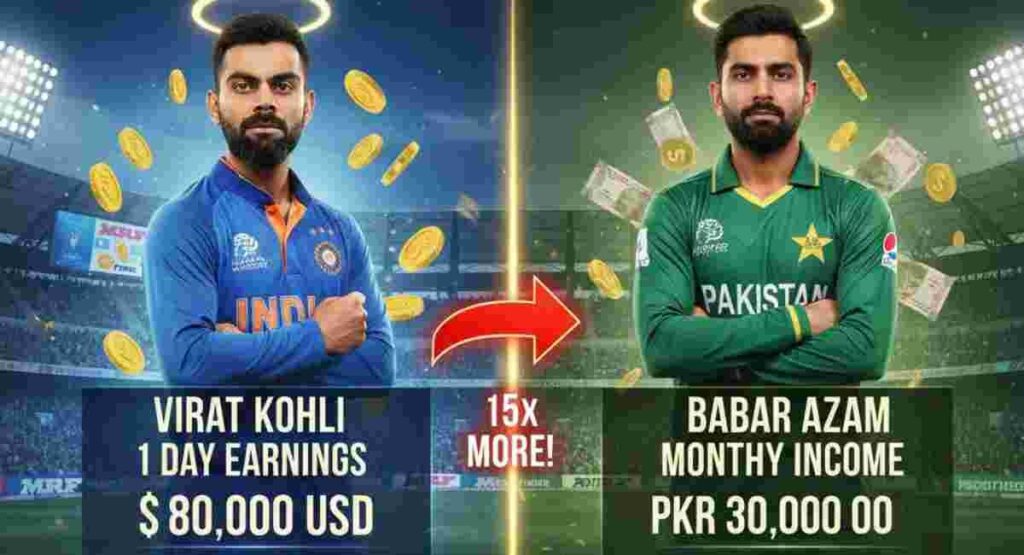
2. VIRAT KOHLI DAY INCOME VS. BABAR AZAM MONTHLY INCOME:
Enter the BCCI vs. PCB comparison porn, now much more realistic than its usual absurdity would have us believe.
Virat Kohli gets a ₹7 crore annual retainer fee from the BCCI just for being a part of the Indian team. But his real fortune is his brand endorsements (MRF, Puma, etc.) and IPL deal with RCB (₹21 crore in 2026). If you split his estimated yearly income (approx. ₹250 crore+) into daily income, he makes about ₹68 lakh every day.
In contrast, Babar Azam, the highest-paid player of Pakistan, receives 30 lakh PKR (approx. ₹9 lakh INR) per month in his category B contract.
The Result: Virat Kohli makes more money in 3 hours of brand shoots than Babar Azam makes in an entire month from his national contract.
3. COMPARISON OF MATCH FEES: THE “PAY-PER-PLAY” GAP:
The difference between the BCCI vs PCB goes beyond the retainer, as the BCCI vs PCB also differ in what they pay for each international match.
TEST MATCH FEES:
BCCI: ₹15 Lakh (approx. 50 Lakh PKR)
PCB: 12.5 Lakh PKR
Indian cricketers get 4 times as much for a Test match.
ODI & T20I FEES:
BCCI: ₹6 Lakh (ODI) / ₹3 Lakh (T20I)
PCB: 6.4 Lakh PKR (ODI) / 4.1 Lakh PKR (T20I)
The difference is a little smaller for the shorter formats, although that is still significant when you convert it to a common currency.
4. THE IPL VS. PSL FACTOR:
You can’t discuss BCCI vs PCB without T20 leagues https://cricproz.com/free-entry-t20-world-cup-2026/ coming up.
IPL 2026: The maximum retention cost goes up to ₹21 crore (approx. 70 crore PKR).
PSL 11: The Platinum Level is capped at US$170,000 (approx. 4.7 crore PKR).
Virat Kohli’s salary from the IPL alone is almost 15 times more than Babar Azam salary in the PSL. So Indian players can relax and concentrate on their fitness instead of having to play in a dozen or so global leagues to earn a living.
5. WHY IS THE GAP GETTING WIDER IN 2026?
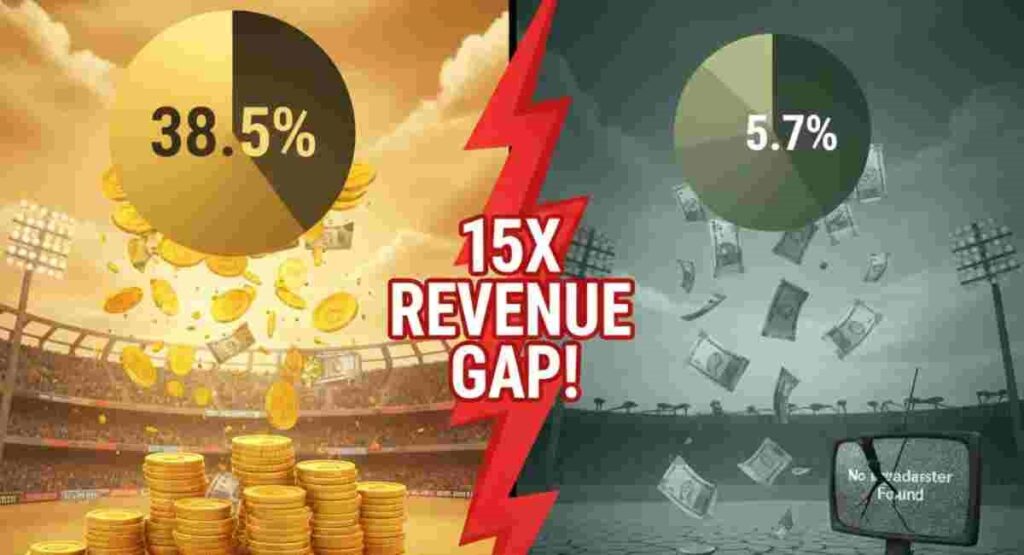
The financial gap between BCCI vs. PCB, is mostly because of the ICC http://ICC Official Website revenue share. BCCI presently takes home around 38.5% of the total ICC income, and the PCB around 5.7% during this cycle. Also, the broadcasting rights for the Indian market (which are sold to Viacom18/Star) are worth billions of dollars, whereas the PCB can barely secure lucrative global broadcasters for its home series.
6. REQUIREMENT OF $500 MILLION “MARQUEE MATCH” ECONOMY:
With BCCI vs. PCB, the commercial value for just one match is monstrous. In a single T20 World Cup game in 2026, between India and Pakistan, he says the revenue will be $500 million (about 1.4 lakh crore PKR).
Broadcaster’s Loss: With the cancellation of a BCCI vs. PCB fixture, the likes of the JetStar broadcasters will lose upwards of ₹300 crore in advertisement revenue.
Ad Rates: Officials said a 10-second advertisement during a BCCI vs. PCB game is priced between ₹25 lakh and ₹40 lakh, which is more than the final of most global tournaments.
7. IPL STARS VS. ENTIRE PSL TEAMS:
The discordance of value, the BCCI vs. PCB money gap, is even more stark in franchise cricket. In the 2026 auctions, the combined IPL salaries of two players—Rishabh Pant (₹27 Cr) and Shreyas Iyer (₹26.75 Cr)—were nearly equal to the entire cost of a new PSL franchise like Hyderabad (sold for approx. ₹55 crore).
Team Purse: According to a report by Hindus Tan’s team, the purse of an IPL team in the bidding is around $14 million, while the whole budget of a PSL team is more than the cap of $1.6 million. This summing up the huge battleground in the BCCI vs. PCB explains why the world’s best players run toward the IPL window.
8. THE ICC REVENUE SHARE “BIG ONE”:
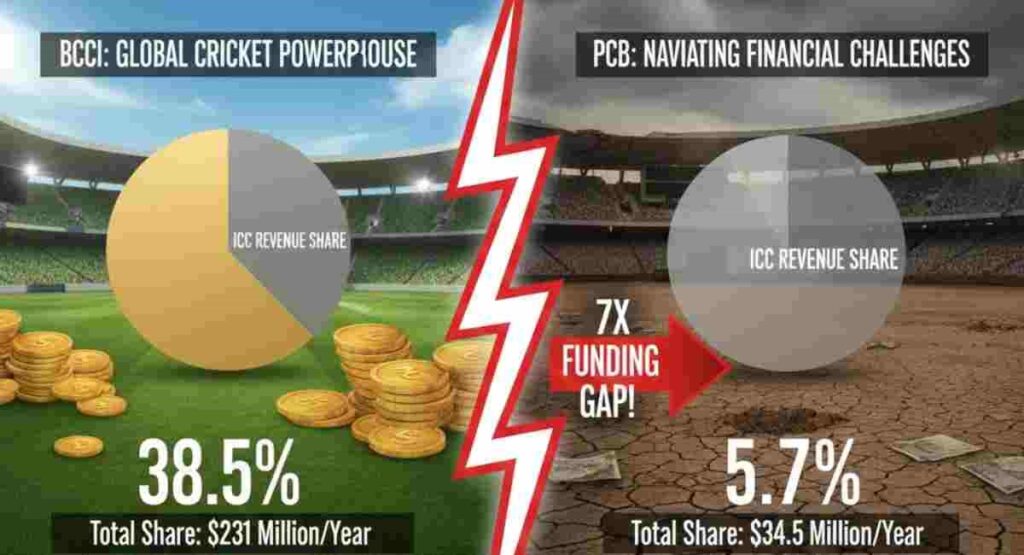
The gap between the BCCI vs PCB has been officially legitimized through the ICC’s financial structure for the 2024-27 term of office periods. 11. BCCI Share India’s share of the total ICC net revenue is 38.5%, which comes to being about 231 million annually.
PCB Share: Pakistan is awarded a mere 5.75%, equal to $34.5 million. The difference in payment between BCCI vs PCB funding is close to seven times in official figures, which gives India a significant upper hand in terms of the development of world-class stadiums and advanced technology academies.
9. PENSIONS AND FINANCIAL SECURITY FOR PLAYERS:
Financial security is a massive bone of contention when comparing the BCCI vs. PCB.
India: Ex-India cricketers are given a monthly pension of a maximum of Rs 50000 with huge medical insurance coverage.
Pakistan: the PCB support positively pales in scale. In 2026, many Pakistani players will be playing in 4-5 different T20 leagues across the globe to make up the security a run-of-the-mill Indian domestic player finds through the BCCI system.
10. INFRASTRUCTURE AND STADIUM UPGRADES:

In 2026, the BCCI vs. PCB divide is clearly apparent on the field. The BCCI has pumped more than Rs 2,000 crore to develop new “smart stadiums” with cutting-edge drainage and LED technology. The PCB, on the other hand, shelling out just under 18 billion PKR for the renovation of Lahore, Rawalpindi, and Karachi for the Champions Trophy, has tightened its domestic purse substantially with the introduction of “Category A” contracts.
11. SUPPORT STAFF & COACHING SALARIES:
The invisible strategic deficit of the BCCI vs. PCB is not just about the players on the field, but the battle also rages between the brains behind the curtains. The difference in income for coaching staff is astonishing.
BCCI’s Big Investment: Team India’s head coach is paid between ₹12 crore and ₹15 crore ($1.5M and $1.8M) in 2026. Plus, bowling and fielding coaches, who specialize in bowling and fielding, receive multi-crore fees to lure the finest tactical brains from across the globe to India.
PCB’s Financial Challenges: Conversely, the BCCI vs. PCB is manifest in the Pak coach cadre. Pakistan’s coaches for both white and red balls are paid a monthly salary of nearly 7.5 million PKR ($30,000), which is roughly R22 million/3 million USD. While not insignificant locally, it’s a fraction of what the Indian support staff is paid.
12. DOMESTIC CRICKET: CRADLE OF RICHES & SKILL:
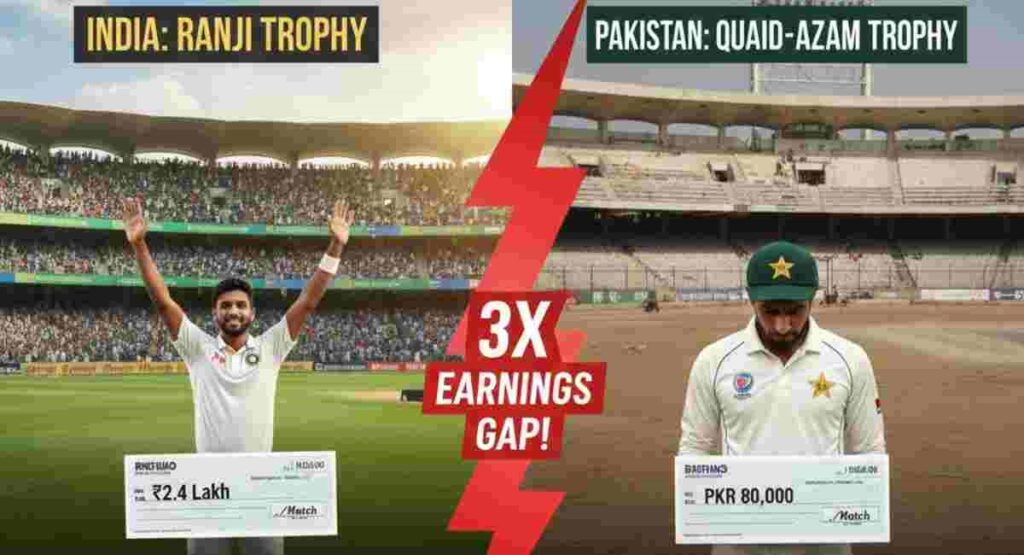
The strength of a cricket board is measured by its domestic setup, and it is in this BCCI vs. PCB tiff where the chasm is the widest. Ranji Trophy (India) A seasoned domestic cricketer in India (with 40+ matches) makes about ₹60,000 per match day, which comes to ₹2.4 lakh (approx. 8 lakh PKR) for a single four-day match.
Quaid-e-Azam Trophy (Pakistan): On the other hand, a cricketer gets a match fee of 80,000 PKR in any one of Pakistan’s top domestic tournaments.
The Takeaway: The average Indian domestic player makes more money in a single Ranji season than a ‘Category C’ Pakistani international does from its entire yearly national contract. And that means Indian children can concentrate just on cricket.
13. TRAVEL ACCOMMODATIONS: BUSINESS CLASS VS. BUDGET TRAVEL:
The BCCI vs. PCB Quality of Life Difference The difference in lifestyles regarding the BCCI vs. PCB saga can be seen most clearly during international tours.
The BCCI Lifestyle: The Indian players travel only in business class or private chartered flights on long-haul tours. Their accommodation is entirely in global 7-star hotels, all expenses paid by the board’s gigantic commercial kitty.
PCB’s Financial Ruin: In the wake of the Champions Trophy 2025 financial debacle (an $85 million loss), the PCB has begun enforcing the strictest “austerity measures.” Travel budgets have been drastically cut, and admin fees have been slashed, meaning that the Pakistani cricketers frequently have to contend with stiffer travel logistics and budget accommodations that don’t assist with mental and physical recovery on long tours.
14. MEDICAL AND FITNESS INFRASTRUCTURE: AI VS. TRADITIONAL:

Fitness is now a science, and the BCCI and PCB infrastructure divide is widening as a result of technology.
The BCCI’s NCA Revolution: The BCCI has poured in over ₹2,000 crore in the new National Cricket Academy (NCA) in Bengaluru. Using artificial intelligence (AI) and wearable technology, this world-class facility tracks in real time every player’s workload and risk of injury. PCB’s High-
Performance Problems: Although the PCB continues to operate high-performance centers, they are nowhere near the state-of-the-art sports science and specialist medical (including top-flight foreign sports psychologists) that the BCCI has under its wing. In the absence of funding, Pakistan resorts to traditional ways of recovery; India, on the other hand, uses billion-dollar tech to keep its players match-ready.
15. POST-RETIREMENT SECURITY: PENSION AND ONE-TIME BENEFITS:
The BCCI vs. PCB disparity in finances exists right until a player retires. For a lot of cricketers, post-retirement life is difficult financially, and here is how both the boards help their legends in 2026.
BCCI’s Lifelong Security: The BCCI has one of the world’s greatest pension schemes. In 2026, state players (who played 25+ matches) will be given a monthly pension of ₹70,000 (approx. 2.3 lakh PKR) Even the domestic legends who never played for India but played 75+ first-class matches get a monthly stipend of ₹45,000.
The “One Time” Savory: Furthermore, the BCCI grants a “One-Time Benefit” from IPL surplus, where legends can get lump-sum amounts of ₹1.5 crore on the basis of their career span.
16. THE GENDER PAY PARITY REVOLUTION: BCCI VS. WOMEN’S SALARIES IN PCB:
In 2026, the BCCI vs. PCB distinction is the most transformative in the women’s circuit. The men’s gap is all about commerciality, the women’s gap is now a question of policy and historic funding.
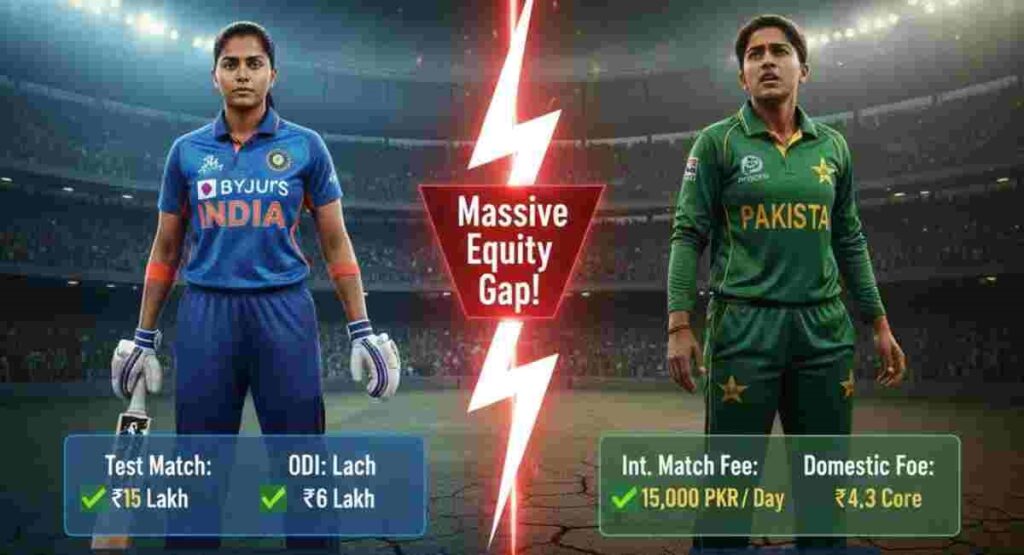
BCCI’s Equal Match Fee Policy: After a landmark ruling, women cricketers of India now get equal match fees as men. Smriti Mandhana is paid ₹15 lakh per Test, ₹6 lakh per ODI and ₹3 lakh per T20I – the same amount Virat Kohli earns for playing one match.
PCB’s Battle for Recognition: Pakistan’s women cricketers are the poorest paid in the BCCI vs. The PCB has raised domestic match fees (from around 8,000 to 15,000 PKR per day), but it is nowhere near the Indian model. according to reports, the fee paid to an Indian domestic women player has now been pegged at ₹50,000 (approx., 1.6 lakh PKR) per day, which is definitely more than what many international players from other countries get paid.
WPL vs. The Global Standard: The Women’s Premier League (WPL) 2026 has an amount of ₹6 crore as the winner’s prize money, which is even more than the prize money in the Men’s Pakistan Super League (approx. ₹4.3 crore).
The “Billion-Dollar” Disparity: The way the BCCI treats vs. the way the PCB treats its women highlights how India is using its immense wealth to pave a viable career path for girls, while Pakistani women cricketers frequently don’t have access to even basic high-performance facilities or long-term financial support that would allow them the ability to play the sport full-time.
CONCLUSION:
BCCI vs. PCB FINANCES 2026 Nothing in cricket changes ever! The 3-decade BCCI, PCB financial saga epitomizes the commercial development of cricket. The spirit of the game might be the same on the field, but the business of the game has spawned two entirely different atmospheres. The BCCI has managed to make cricket into a multi-billion-dollar industry, with its players being the richest sportsmen in the world.
The off-field picture is a different one, with the PCB trying to find its way through austerity and restructuring and concentrating on developing its grassroots amid severe financial constraints. In the end, the BCCI vs. PCB gap isn’t just about bank balances—it’s about the power of market size and strategic investment. To the fans, the hope is that although the financial divide is growing, the competition on the field will be as intense as ever, because no matter how much money you have, you still can’t buy excitement in a last-ball thriller between these two giants.
Frequently Asked Questions (FAQs)
Q1: What makes BCCI so much richer than the PCB in 2026?
Ans: The biggest driver of the BCCI vs. PCB riches disparity is the Indian market. India generates about 70-80% of revenue of world cricket. Profitable broadcasting rights agreements (such as the $6 billion IPL rights) and the ICC revenue pool, from which the BCCI receives a mammoth 38.5 percent, give the BCCI a colossal financial advantage.
Q2: Top BCCI among highest-paid cricketer in PCB?
Ans: As of 2026, Virat Kohli is the top-earning cricketer. The total sum of his income from BCCI Grade A+ contract, IPL (₹21 Crore) and Brand Endorsement is estimated to be more than ₹250 Crore per annum. In Pakistan, Babar Azam heads the list, but he is nowhere close to making as much money, mostly because he doesn’t have as big domestic league caps.
Q3: How much more or less does an Indian domestic player make than a Pakistani international player?
Ans: Surprisingly, a Senior Indian domestic player (participant in the Ranji Trophy) can make up to ₹60,000 per day, which can fetch them over ₹1 Crore in a year considering match fees and state contracts. This is much more than what your typical “Category C” or “D” international Pakistani player makes in terms of national contracts.
Q4: Is it true that the PCB abolished the “Category A” contracts from 2026 for all players?
Ans: Yes, the PCB did not announce any category “A” contracts in a massive overhaul in late 2026. Some of the top stars like Babar Azam and Mohammad Rizwan were demoted to Category B due to an austerity measure following infrastructure investment for the Champions Trophy.
Q5: Do Pakistani players get a kind of pension similar to that of Indian players?
Ans: Yes, both boards have pension schemes, but the scale varies. While veterans in the BCCI are entitled to a pension that can fetch up to ₹70,000 per month, in the PCB the maximum pension slab is around 154,000 PKR (approximately ₹46,000 INR).
Q6: Do the T20 contracts in the PSL compensate for low salaries from the PCB?
Ans: The PSL is a good source of income for Pakistani players, with platinum cricketers bagging up to $170,000. But in contrast to the BCCI and PCB scenario, the IPL’s highest domestic retention is 2.5 million, about 15 times more than the highest PSL retention, which is $1,245,000, suggesting that PSL revenues will not be sufficient to bridge the gap.